
Military installations are among the most complex and demanding security environments in the world. They must protect personnel, classified information, weapons systems, critical infrastructure, and mission operations — often across large, geographically diverse footprints with thousands of daily access events.
A single-layer security approach is no longer sufficient. Today’s military base security requires a fully integrated system — one where the perimeter, entry points, interior zones, and command infrastructure all work together as a unified, intelligent platform.
This article explores how integrated security systems reduce risk at military installations, what the key components look like in practice, and what commanders and facility security officers should demand from their security systems integrator.
For years, many installations operated their Intrusion Detection Systems (IDS), Physical Access Control Systems (PACS), and video surveillance as separate, siloed systems managed by different teams and different software platforms. The result was predictable: delayed response times, gaps in situational awareness, and redundant staffing costs.
Modern DoD physical security doctrine — reflected in standards like UFC 4-021-02 — explicitly calls for integrated electronic security systems. The reason is straightforward: when your IDS, PACS, and CCTV share a common operating picture, your security force responds faster, with better information, and with fewer false alarms consuming limited personnel resources.
Integration is not a luxury upgrade. It is the baseline for effective military base security in the current threat environment.
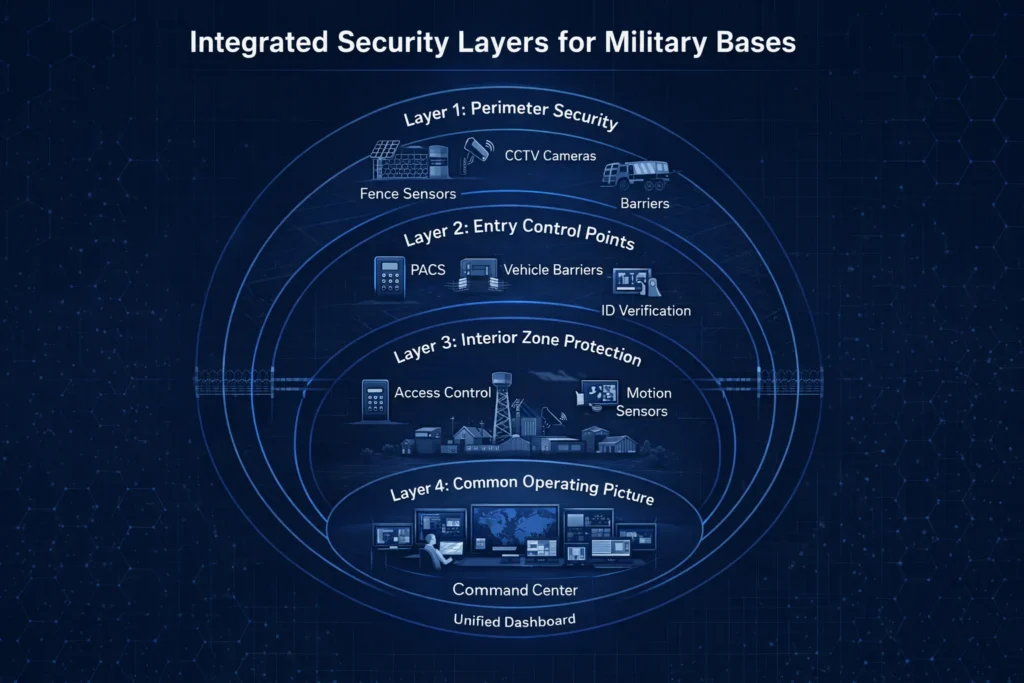
Every integrated security strategy starts at the perimeter. For a military installation, the perimeter is the first and most critical line of defense — and it must be treated as such.
The perimeter layer buys time. Time is what enables every subsequent layer of the security system to function effectively.
Effective perimeter security typically includes:
Access control at installation entry points is where identity verification meets physical security. Modern military entry control must balance two competing demands: rigorous screening of everyone who enters, and throughput fast enough not to create bottlenecks that become security vulnerabilities themselves.
Key capabilities at the entry control layer include:
Not everyone with legitimate access to an installation has access to every area within it. Sensitive compartmented areas, armories, communications nodes, and command facilities require interior zone protection that mirrors — and integrates with — the perimeter and entry layers.
Interior zone security includes:
All three physical layers are only as effective as the command-and-control infrastructure that ties them together. This is where the security management software platform becomes the decisive factor.
A unified platform — like Advantor’s ASN (Advantor Suite for Networks) — gives security operations center personnel a single screen view of all alarms, access events, camera feeds, and system status across the entire installation. When an IDS alarm triggers at the north perimeter, ASN automatically associates that alarm with nearby camera feeds, locks down relevant access points, and alerts the appropriate response team — in seconds, not minutes.
This is the difference between a collection of security technologies and a genuinely integrated security system.
Not all integrators are equipped to deliver true integration at the scale and complexity of a military installation. When evaluating an integrator, demand:
Military base security is too important — and too complex — to be treated as a collection of separate technology purchases. A fully integrated security system, layered from the perimeter inward and unified by a common operating platform, is the standard that modern DoD security requirements demand and that today’s threat environment requires.
The installations that get this right are the ones that choose their security systems integrator as carefully as they choose their mission systems.
With 50+ years of experience delivering integrated ESS for DoD and high-security federal facilities, we understand what it takes to protect a military installation from the perimeter in.